

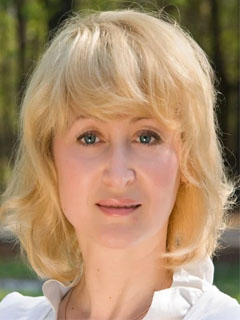
Education and Career
She graduated from Kharkiv Polytechnic Institute (KhPI), Faculty of Automation and instrument engineering, with a degree in Іnformation-measuring technology.
1995 – Ph.D. student of the Design Automation Department, Faculty of Computer engineering and control, Kharkiv Technical University of Radio Electronics (KhTURE).
1999 – She was awarded the Ph.D. degree at the Kharkiv National University of Radioelectronics (KhNURE). She defended the dissertation on the specialty 05.13.12 – Design Automation Systems.
1999 – Senior Lecturer at the Occupational Safety Department (KhNURE).
2005 – Associate Professor of the Occupational Safety Department (KhNURE).
2009 – Associate Professor of the Design Automation Department, Kharkiv National University of Radio Electronics (KhNURE).
2016 – she received the scientific title of Associate professor of the Design Automation Department.
Educational activity
Teaches courses: «Сomputer automatic control systems», «Specialized algorithms and architectures», «Microelectromechanical systems», «Design for specialized architectures of computer systems».
Researcher activity
Areas of scientific activity: functional real-time computers design for distributed control systems, specialized stream processing modules for sensor components’ signals, mathematical modeling.
International activity / participation in international projects
Tempus project “Development for new Specialization”, “Master of Engineering in Microsystems Design”: professional staff training, Lodz University of Technology, Poland, “Microsystem design technologies”, 2016.
Social activities
Trade unionist of the Computer Engineering and Control faculty (2010-2018), group curator.
Publications and patents
Has more than 60 scientific publications, including those indexed in the scientometric databases Scopus and Web of Science, 2 inventor’s certificates, 1 study guide and 10 methodological publications.